
Memorial of Saint Pius of Pietrelcina, Priest


Once when Jesus was praying in solitude, and the disciples were with him, he asked them, “Who do the crowds say that I am?” They said in reply, “John the Baptist; others, Elijah; still others, ‘One of the ancient prophets has arisen.’” Then he said to them, “But who do you say that I am?” Peter said in reply, “The Christ of God.” In today’s Gospel reading, the words the disciples use to describe who people think Jesus is are nearly identical to those that Herod had been hearing: “John has been raised from the dead”; others were saying, “Elijah has appeared”; still others, “One of the ancient prophets has arisen.” This is to say that only Mary, Joseph, and a few close followers knew who Jesus was, as Peter said: “The Christ of God.”


Every day, Lord, I face the battle of the seen versus the unseen; that is, I know you are alive and present, but I give precedence to things seen and sensed. While Peter and others saw you face to face in his present reality, that seeming advantage is surpassed by your presence in the sacraments, in your real presence in the Eucharist. Thank you, God, for these gifts that Jesus instituted by his life. At various times, I have wondered about my faith in you, Jesus, and doubted my beliefs. I want to see you with the certainty of sight that the eyes of faith give. Help me see you and know who you are.


Jesus, thank you for asking the disciples the same question you ask me: “Who do the crowds say that I am?” It causes me to question in what or in whom I place my identity. As the Psalms say, what am I that you take notice of me? “Man is like a breath; his days, like a passing shadow.” Yet, Lord, you have put the timeless into our hearts. As Padre Pio says, “Admire the heavenly regions which can be reached by no other road than that of suffering. This is our true home.”


Glory be to the Father, and to the Son, and to the Holy Spirit. As it was in the beginning, is now, and ever shall be, world without end. Amen.




Readings


Thursday of the Twenty-fifth Week in Ordinary Time


“But Herod said, ‘John I beheaded. Who then is this about whom I hear such things?’ And he kept trying to see him.” In the Gospel reading according to Luke, Herod is perplexed by Jesus. Who is this Jesus he kept hearing about, and what does it mean that he kept trying to see him?


The first reading from Ecclesiastes might have given Herod some consolation as he restlessly sought answers: “The eye is not satisfied with seeing nor is the ear satisfied with hearing.” Nothing anybody could have told Herod about Jesus would have satisfied his restlessness. Even when Herod and Jesus met before his crucifixion, Herod was hoping to see Jesus perform a miracle. But it wouldn’t have satisfied him. The eye is not satisfied with seeing. I wonder how I am like Herod as each day passes. The despair that Qoheleth expresses in Ecclesiastes I would rather not participate in, yet I go on participating every day. “All speech is labored; there is nothing one can say.” What thing is there that has not been? What can be said that has not been said, or what can be done that has not been done? “Nothing is new under the sun.”


God, help me understand that the restlessness that Herod feels and the resignation of Qoheleth are realities that life presents. Yet, standing at the edge of this chasm of discontent and futility is the Good Shepherd, protecting his flock. There, amid the perplexity of human thought and worldly wisdom is the Son who sits at the right hand of God the Father and who says, “‘Behold, I make all things new.’ Then he said, ‘Write these words down, for they are trustworthy and true.’” The end of human thought and wisdom is not a place of futility; at its end is a person—the risen Christ. Help me remember this, Lord, and to understand that you are not only present at the limits of human reason but present in the midst of daily thoughts and yearnings.


Jesus, I know that you want for me to have peace that is based on truth. “Consecrate them in the truth,” you say in prayer to your Father. “Your word is truth.” Teach me today to live in the truth of God the Father. Herod kept trying to see you. Show me how to see the truth of your word and live in it.


Glory be to the Father, and to the Son, and to the Holy Spirit. As it was in the beginning, is now, and ever shall be, world without end. Amen.


Readings


Feast of Saint Matthew, Apostle and evangelist


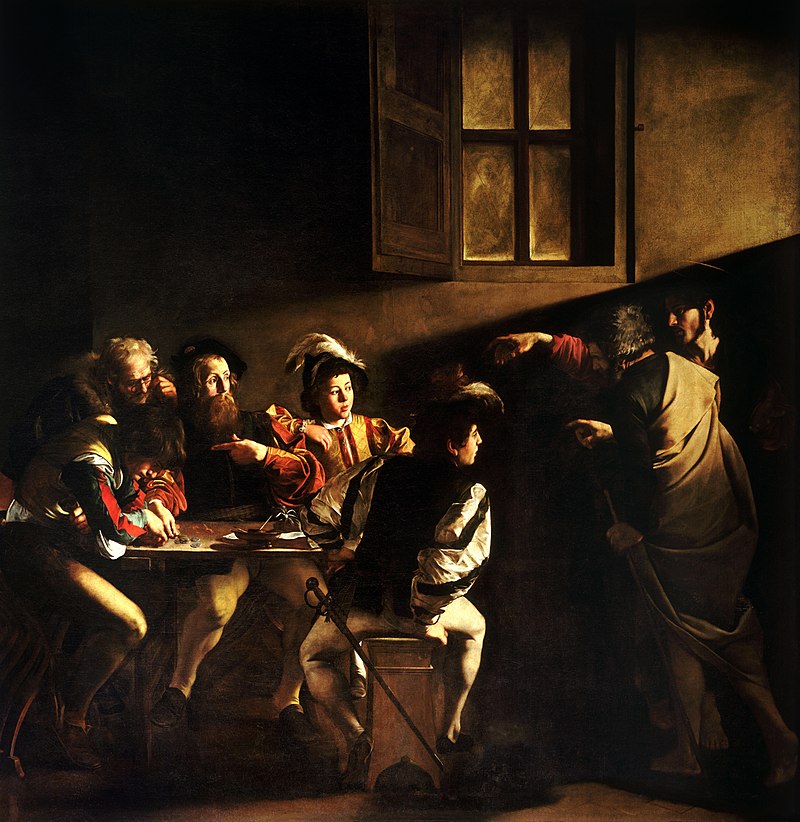
“As Jesus passed by, he saw a man named Matthew sitting at the customs post. He said to him, ‘Follow me.’ And he got up and followed him.” In today’s Gospel reading, Matthew immediately drops whatever he is doing and follows Jesus.


The painting by Caravaggio, The Calling of Saint Matthew, shows Matthew among four others, who also appear to be tax collectors. Matthew is hunched over a table, counting change as another tax collector helps him. In his left hand, Matthew clutches close to his chest what appears to be a money bag. The way Matthew slumps over the table and the coins reminds me of the way I must look as I work at my desk during the day, strong in self-reliance and confident in my ability but often forgetting that Jesus says throughout the day, “Follow me.” Just as in the past, the temptation today is strong to cling to what we know. In my own life, there are the attachments to comfort, material goods, and a desire and expectation to earn a certain amount of money and the honor and self-respect that go along with that. How can I be more like Matthew and follow Jesus as he describes in the Gospel: “And he got up and followed him.”


Lord, you know me; you know when I sit and when I stand; you know when I am falling down. There are days when I feel on the losing end—not enough time, not worthy enough, not wealthy enough—and that if I just manipulated one more thing, things would turn around for me. I think that “me” is what you called Matthew out of. He left the company of tax collectors, the money bag he clutched, and the desperate sense that there is not enough, that there would never be enough. You came to him, Divine Physician, because he was sick and needed to lose his life through following you to find your unfathomable mercy.


I believe Jesus called Matthew in the same way he called Peter to walk on the water. Both were planted firmly on the solid ground of their professional lives: Matthew at his customs post and Peter in his fishing boat. Lord, say to me today: “Follow me.” I can’t be certain I will do your will or that I will even hear you. Let your grace make clear to me what it is you have to give to me. Let me realize that in your love there is enough; there is more than enough.


Glory be to the Father, and to the Son, and to the Holy Spirit. As it was in the beginning, is now, and ever shall be, world without end. Amen.


Readings


The Calling of Saint Matthew

Memorial of Saints Andrew Kim Tae-gŏn, Priest, and Paul Chŏng Ha-sang, and Companions, Martyrs


The mother of Jesus and his brothers came to him but were unable to join him because of the crowd. He was told, “Your mother and your brothers are standing outside and they wish to see you.” He said to them in reply, “My mother and my brothers are those who hear the word of God and act on it.”


The Gospel reading says that Mary and Jesus’ brothers—from Greek, adelphoi, or member of the same religious community—could not join him because of the crowd. Jesus was told that by someone who remains unknown. Did that person believe that Jesus’ mother and brothers had privileged access to him, despite the crowd? By his reply, in no way does Jesus diminish the role of his mother or brothers by saying those who hear the word of God and act on it are his mother and brothers. Are there times when I believe I have privileged access to Jesus, even without hearing and doing his will?


Thank you, God, for the clarity of your Son’s statement. Hear your word and act on it. Hear and act. Without the burden of guilt and shame, I desire to hear and do your will throughout the day. If I were to act only out of guilt or out of shame in recovering from a misstep, I can’t say that is desire to be in your presence. I sometimes believe I am better at identifying what your will is not than what it is. Help me understand how to avoid turning in the wrong direction so that I can keep you in my line of sight and recognize what is your will.


Just as Mary and Jesus’ brothers desired to join him, I also desire to put myself in your presence. Let nothing impede that today; let me hear and act. Stay with me, Lord, and let me know your outlandish love for me.


Glory be to the Father, and to the Son, and to the Holy Spirit. As it was in the beginning, is now, and ever shall be, world without end. Amen.


Readings